You have decided that AI needs a place in your business. Maybe you are looking for a new website, maybe you want to automate processes, or maybe you do not know exactly what yet. What you do know is that standing still is not an option. Competitors are moving, customers expect more, and you do not want to be left behind.
So you start looking for an agency that can help you. And everywhere you see the same thing: "AI driven solutions", "We work with AI", "The future of digital". It sounds promising. Finally, people who understand what you are after.
Until you ask for a quote.
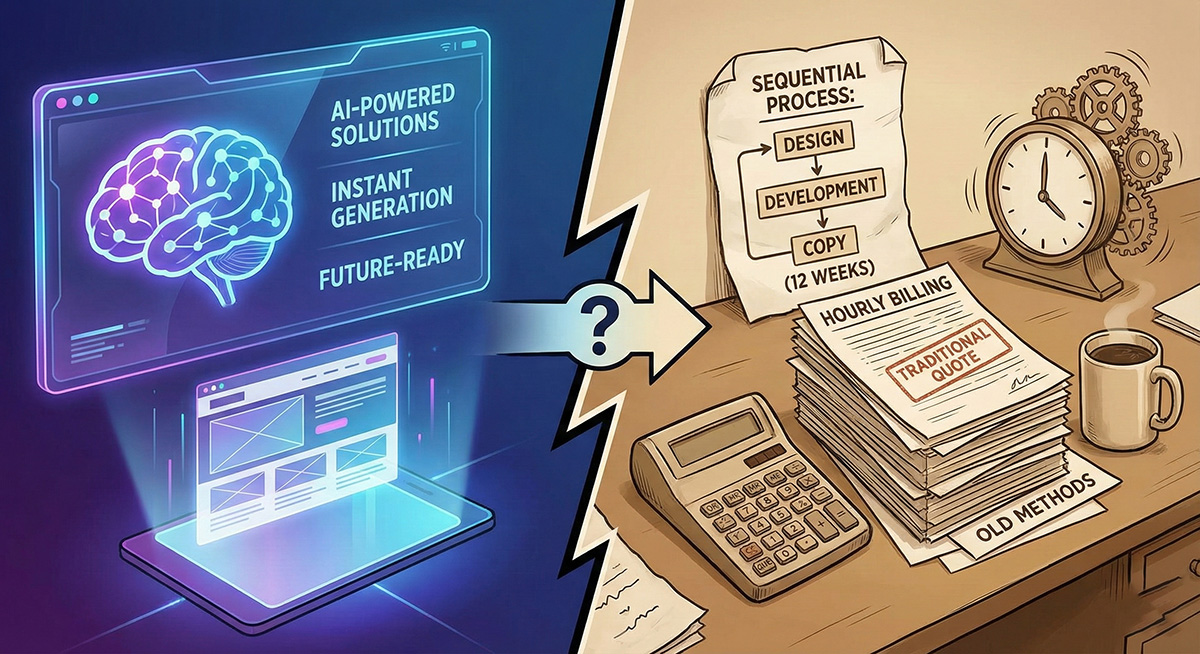
Because then you get a document that looks exactly like it did five years ago. Design: so many hours. Development: so many hours. Copywriting: so many hours. Lead time: ten to twelve weeks. The same structure, the same phases, the same way of working.
The word AI appears in the introduction. In the rest of the document it never comes back.
What "we work with AI" means in practice
At most agencies it means this: someone in the office has a ChatGPT account. The copywriter sometimes uses it for a first draft. A designer occasionally generates a moodboard with Midjourney. And that is it.
The process itself has not changed. Design is made separately. Development only starts once the design has been approved. The copywriter is the last to hear what needs to happen. Everything sequential, everything in separate steps, everything invoiced separately.
AI is on the website. Not in the way they work.
Why it stays this way
The reason is not that agencies are lazy or behind the times. The reason is a business model that protects itself.
The traditional model is built on hours. More meetings means more billable time. More iterations means more revenue. A more efficient process would mean there is less to invoice. For many agencies that is not an attractive prospect.
On top of that, really integrating AI is not simple. It asks you to redesign the way you work. To invest in knowledge and tooling. To accept that experiments sometimes fail. Most agencies have not taken that step. They added a term to their pitch, they did not carry out a transformation in their process.
The result: a market full of agencies that claim AI but do not deliver it. And you pay the difference.
We have been doing this differently for years
At Green Creatives we did not start following AI the moment it became a buzzword. When the first generative models became available, we were already testing. Not to be out in front of the hype, but because we could see this would fundamentally change the way we work.
After more than twenty years in this trade we know one thing: processes have a tendency to keep themselves alive. "This is how we always do it" is an expensive habit. We decided to let that habit go and rebuild our process from the ground up, with AI as the starting point rather than an extra.
While other agencies are going through the teething problems now, we have those behind us. We know what works. What does not work. And when you are better off not using AI at all.
What this means for the way we work
The difference starts with the first question we ask. Most agencies begin with: "What should your website look like?" We begin with: "Who is your customer?"
Before we design anything, we map out your ideal customer. Not an abstract target group, but a concrete profile. What are the pain points? The motivations? The language they use? This becomes the basis for everything that follows: design, copywriting, development. One foundation, no separate islands.
From that profile we build a master prompt: a central briefing we use for the whole project. Design and development run in parallel. We do not present static designs, we present working prototypes. Giving feedback becomes concrete: you see not only what it looks like, but how it works.
Meanwhile the copy is written on the basis of that customer profile and the tone of voice. With Claude, ChatGPT, or European models such as Mistral where privacy matters. AI writes the first versions, people refine them. You have the final word.
The impact
Projects that traditionally take two to three months, we deliver in four to six weeks. Not by rushing, but by running phases in parallel and asking the right questions up front.
The investment is on average thirty percent lower than at traditional agencies. Not because we compromise on quality, but because we are not paid for inefficiency. Our incentive is to work smart, not to stack up hours.
That is the fundamental difference. We do not benefit from a long process. You do benefit from a short one.
How to spot the difference
When you are talking to agencies, do not ask which AI tools they use. Ask about their process.
An agency that has genuinely integrated AI does not start with design, it starts with your audience. They talk about parallel workstreams. They can explain how AI changed their approach, not just their toolbox.
And look at the quote. Does it reflect a new way of working? Or do you see the same structure as five years ago, with AI added to the introduction?
If the lead time and the investment are identical to what agencies asked for back then, AI is nothing more than marketing.
The choice
You can work with agencies that have AI in their pitch but not in their process. That still produces working results. But you are also paying for a model that has not moved with the times.
Or you choose an agency that has spent the past few years investing in a new way of working. That combines twenty years of experience with an approach that fits the moment. That does not pocket the efficiency gain, but passes it on to you.
Let us talk about what AI can mean for your organisation. No sales pitch, just a proper conversation. That is how we like to do it.