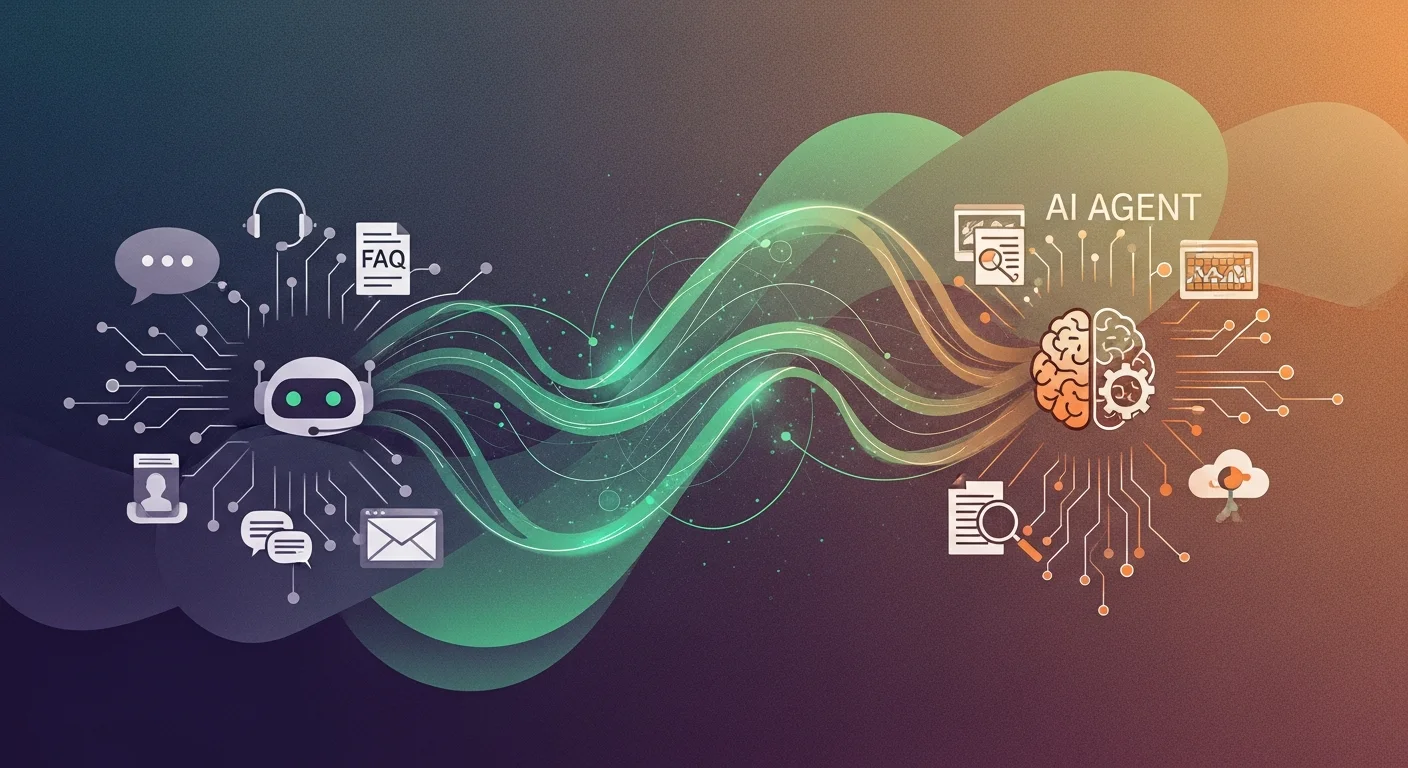
The terms "chatbot" and "AI agent" get used interchangeably all the time, but they describe fundamentally different technologies. Picking the wrong one leads to frustration, wasted investment and missed opportunities.
In this article we explain the difference and give you a practical decision tree so you can make the right choice for your business.
What is an AI chatbot?
A chatbot is an automated conversation partner that responds to input according to rules or patterns defined in advance.
What defines a chatbot:
- Reactive: it waits for input from the user
- Script based: it follows decision trees or intent matching
- Limited scope: it answers questions within set boundaries
- No external actions: it cannot drive other systems by itself
Typical chatbot use cases:
- Answering FAQs on websites
- Simple customer service (opening hours, locations)
- Lead qualification with standard questions
- Appointment scheduling with fixed options
Example: a chatbot on a webshop that asks "What can I help you with?" and points the visitor to the right product category.
What is an AI agent?
An AI agent is an autonomous system that makes its own decisions, carries out actions and handles complex tasks without a human in the loop.
What defines an AI agent:
- Proactive: it can act without being prompted
- Goal driven: it works towards an outcome, not just a reply
- Multi step reasoning: it can break a complex task into steps
- System integration: it carries out actions in your CRM, ERP, email and databases
Typical AI agent use cases:
- Running complete lead nurturing workflows
- Generating and sending quotes automatically
- Customer service with access to order history and returns processes
- Document analysis and contract review
- Autonomous sales outreach with follow ups
Example: an AI agent that receives a new lead, researches the company automatically, sends a personalised email and schedules the follow up in your CRM.
Chatbot vs agent: the comparison table
| Aspect | Chatbot | AI agent |
|---|---|---|
| Complexity | Low | High |
| Autonomy | Reactive | Proactive |
| Integrations | Limited | Extensive |
| Learning curve | Fast | Moderate |
| Investment | €2,000 to €5,000 | €10,000 to €50,000+ |
| Implementation time | 1 to 2 weeks | 4 to 12 weeks |
| Maintenance | Low | Moderate |
| ROI potential | Moderate | High |
Decision tree: chatbot or AI agent?
Answer these questions to work out what fits your situation:
1. How complex are the tasks you want to automate?
Simple (FAQs, standard questions) → chatbot Complex (multi step workflows, decisions) → AI agent
2. Does the system need to carry out actions in other software?
No (information only) → chatbot Yes (updating your CRM, sending emails, creating quotes) → AI agent
3. What is your budget for the initial investment?
Under €5,000 → chatbot €10,000 to €50,000+ → AI agent
4. How many manual hours do you want to save?
Under 10 hours a week → chatbot 10+ hours a week → AI agent
5. Do you have an IT department or technical knowledge in house?
No → start with a chatbot and grow into an agent Yes → consider going straight to an AI agent
Real examples per sector
Financial services
Chatbot: answering questions about interest rates, terms and product information.
AI agent: processing a complete mortgage application. Analysing documents, assessing risk, following up with the client and preparing the file for the adviser.
Law firms
Chatbot: asking intake questions and routing the enquiry to the right practice area.
AI agent: analysing contracts, flagging red flags, writing a summary and comparing clauses against standard wording automatically.
E-commerce
Chatbot: answering product questions and guiding visitors to the right category.
AI agent: handling a complete return. Generating the return label, updating stock, processing the refund and notifying the customer.
The hybrid approach: start small, grow smart
Many successful implementations follow this path:
- Phase 1: start with a chatbot for the most common questions
- Phase 2: measure where the chatbot gets stuck (escalations to people)
- Phase 3: upgrade to an AI agent for those specific bottlenecks
- Phase 4: extend the agent with more integrations and more autonomy
This approach keeps the risk low and the learning high.
Common mistakes
Mistake 1: going straight for an agent without the basics
An AI agent is only as good as the data and processes behind it. Without clear workflows and clean data, an agent will not perform.
Mistake 2: expecting a chatbot to behave like an agent
"Our chatbot also needs to send emails and create quotes." That is not a chatbot, that is an agent. Do not expect agent functionality at chatbot prices.
Mistake 3: not measuring ROI
Both solutions cost money. Without clear KPIs (hours saved, conversion improved, tickets reduced) you have no idea whether the investment is paying off.
Conclusion: what fits your business?
Choose a chatbot if:
- Your budget is limited
- Your tasks are simple and repetitive
- You want to get going quickly
- You do not need complex integrations
Choose an AI agent if:
- You want to save significant hours on complex tasks
- Your systems need to work together (CRM, ERP, email)
- You want autonomous decision making
- You are willing to invest in a robust solution
Still in doubt? Take our free AI Readiness Scan and find out which solution fits your business best.
Next steps
Want to know concretely what an AI agent costs, or have a look at our 15 AI agent use cases for inspiration.
Ready for the next step? Have an AI agent built by our specialists.